
App Store 4.3(a) Spam Rejection Remediation Guide: IPA Multi-Dimensional Similarity Detection and Pre-Submission Review
For App Store 4.3(a) Spam rejection scenarios, this provides a complete process from fixing a detection baseline, IPA multi-dimensional similarity detection, remediation according to the report, to pre-submission review, along with a checklist and an explanation of compliance boundaries.
One. Introduction to the Problem: Why 4.3(a) Is Judged as Spam
App Store Review Guideline 4.3(a) targets duplicate content and spam apps. In practice, rejected apps often do not have identical functionality; rather, they highly overlap with existing apps in the library across dimensions such as the main executable, Framework, resource files, Assets.car, SDK fingerprints, and network interfaces.
Common triggering scenarios include:
- Using the same base framework to wrap multiple projects, changing only the brand and skin;
- Template code without substantive refactoring, with highly consistent class names, method names, and package structures;
- Directly reusing resources and packaging structure, copying images, Assets.car, and string tables as-is;
- Control flow and data flow semantics are too close, and business order and state machines are almost isomorphic;
- Third-party SDK fingerprints, network interfaces, and certificate information are not differentiated.
The difficulty with this type of rejection is that it is hard to judge by eye "how much difference counts as similar." Therefore, the first step of systematic remediation is not to change code, but to first perform reviewable similarity detection, then remediate item by item according to dimensions. The entire process can be summarized as:Quantify first, then remediate, then review
Two. Step-by-Step Tutorial: From Detection to Remediation
Step One: Fix the Baseline Before Detection
Prepare one reference package (a similar package in the database or your own already-published package) and one package to be detected, record the version number and build number, and ensure subsequent changes can be compared. It is recommended to first run a complete detection without remediation as the "pre-remediation score"; otherwise, it will be impossible later to judge whether the changes actually worked.
The detection process should be completed independently, without retaining IPA files, and with automatic deletion after detection, to avoid association risks involving the IPA or account.
Step Two: Perform Multi-Dimensional Similarity Detection
On the iOS side, it is recommended to cover 12 dimensions: main executable, Framework, resource files, Assets.car, metadata, SDK, control flow, data flow and semantic clues, duplicate files, and so on.
The IPA similarity detection tool generates a reviewable technical report from dimensions such as Mach-O, resources, metadata, SDK, and duplicate files, helping teams locate similarity risks before submission. In actual use, it provides the following capabilities:
- Multi-dimensional comparative analysis: Supports similarity detection across multiple dimensions such as the main executable, Framework, resource files, and Assets.car, and can comprehensively analyze the degree of similarity between two IPA files to prevent 4.3(a) issues encountered during publishing;
- Massive database: With feature data from a database of more than ten thousand apps, it can comprehensively and quickly perform comparative detection to prevent 4.3(a) issues during publishing caused by similar base frameworks;
- Ensure absolute security: The detection process is completed independently, IPA files are not retained, and they are automatically deleted after detection, so no IPA or account association will be generated.
Among them, SHA-256 exact matching is used to find completely identical files; control flow, data flow, and semantic clues are used to find cases of "rewritten but structurally similar." Only by combining the two can surface-level and deep-level duplication be covered. The report should retain scores, tables, and suggestions as the basis for remediation, rather than only taking a screenshot of the total score.
Step Three: Remediate in the order of the report
Remediation suggestions should be advanced in the following order:
- First handle exact-match issues: Identical images, Assets, SO libraries, and string tables should be replaced or redone;
- Then handle structural similarity: class and method naming, package structure, directory layout, network interfaces, and SDK fingerprints;
- Finally handle logical similarity: business process order, state machines, data models, and key algorithms should be designed differently based on real requirements, rather than merely changing variable names.
After remediation, re-run detection to confirm that scores in each dimension have decreased, and record the change points to form a reviewable process description. This description is more persuasive in appeals or subsequent submissions than empty verbal explanations. If a certain dimension's score remains high, prioritize checking whether an entire block of code or an entire resource directory has been reused as is.
Step Four: Review before submission for review
After remediation is completed, it is recommended to run a complete detection again as the "post-remediation score" and compare it with the pre-remediation score. If the team is large, certificates, Bundle IDs, provisioning profiles, and upload tasks can be managed centrally to reduce duplicate submission problems caused by messy materials. Before submission for review, confirm: the versions of the reference package and the package to be detected have been recorded, reports for each dimension have been retained, and remediation points have been mapped to specific files or modules.
Three, Checklist
- Have the reference package and the package to be detected been selected, and have the version and build number been fixed?
- Does it cover dimensions such as the main executable file, Framework, resources, Assets.car, SDK, control flow, data flow, and duplicate files?
- Have files with exactly the same SHA-256 been handled?
- Have SDK fingerprints, network interfaces, and certificate information been differentiated?
- Are the resources and directory structure still highly consistent with the reference package?
- After remediation, has detection been re-run and the report retained?
- Does the detection process avoid retaining IPA and avoid generating account association?
Four, Applicable Conditions and Boundaries
This process applies to teams that develop in-house or commission development and have actual control over code and resources. If the App depends on third-party frameworks and cannot be modified, the replaceable space should be evaluated first.
If the content involves compliance qualification categories (such as gambling, finance, and other restricted categories), similarity remediation cannot replace qualification requirements. Similarity detection and remediation are means to reduce 4.3(a) risk and do not constitute a guarantee of passing review.
The figure below shows the review notification for a simulated gambling app submitted by an individual developer account being rejected (2025-11-01). This is a restricted category qualification issue, which is a different dimension from similarity remediation and must be handled separately.
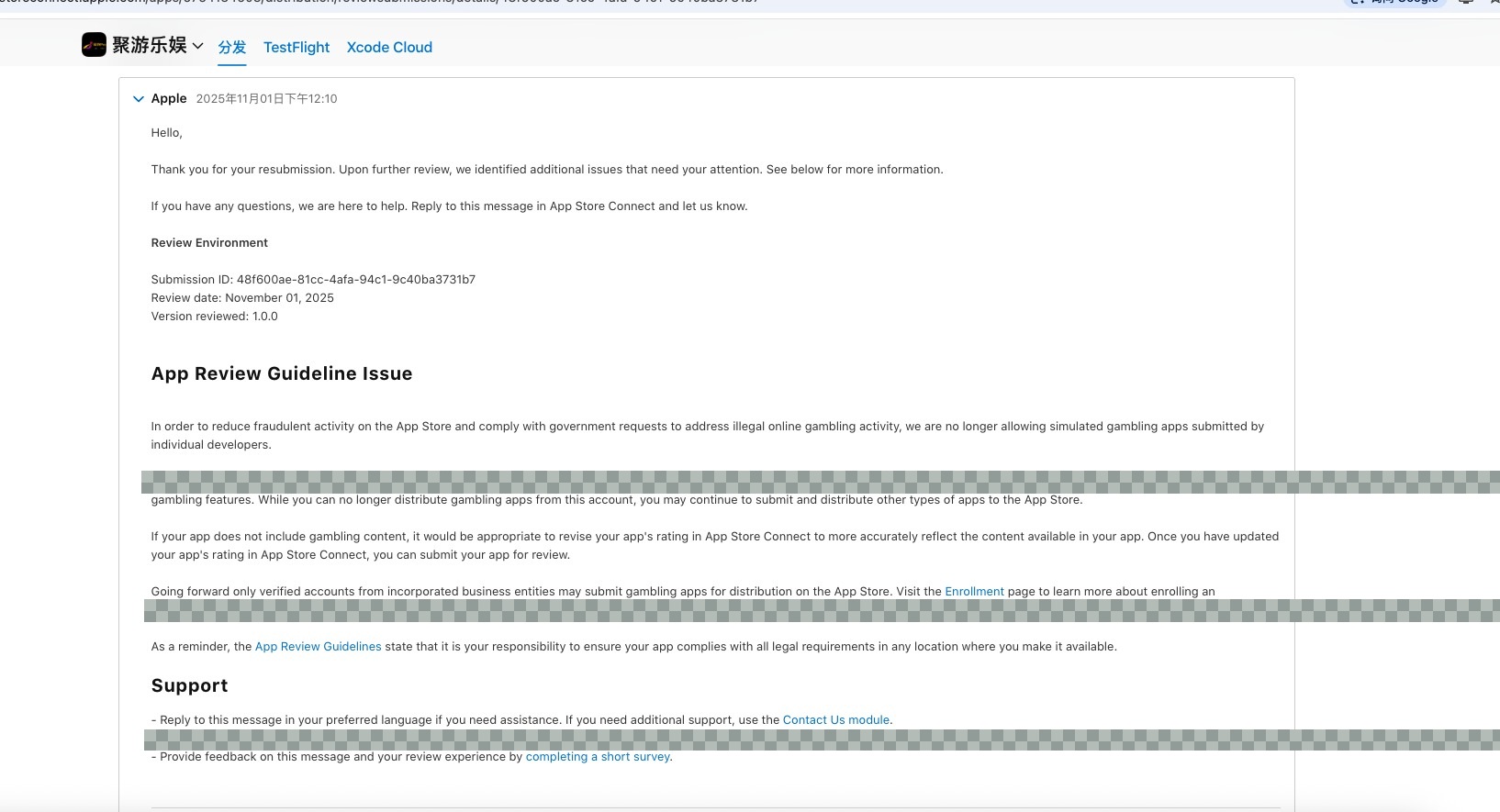
App Store review rejection: Issue with a simulated gambling app submitted by an individual developer account (2025-11-01)